Passport Authentication Solutions for Foreign SIM Registration in the Telecom Industry
2026-07-22 11:46:25Passport Authentication Solutions for Foreign SIM Registration in the Telecom Industry
Compliance practices built for China's multi-carrier ecosystem and diverse real-name registration scenarios

I. Overview of China's Telecom Carrier Ecosystem
China's telecom industry is generally divided into two carrier types, each playing a distinct but complementary role in the value chain.
1. Mobile Network Operators (MNOs)
MNOs build and operate their own communication networks — owning spectrum resources, base stations, and core networks — and provide basic connectivity services directly to the public. China's three major MNOs are China Mobile, China Unicom, and China Telecom.
Core responsibilities of MNOs include:
- Building and maintaining mobile networks (2G/3G/4G/5G)
- Providing voice, SMS, and data services
- Managing core systems for user authentication, real-name verification, roaming, and billing
- Bearing regulatory responsibility for fraud prevention, real-name compliance, and inter-network settlement
In short, MNOs provide the network infrastructure and connectivity capability.
2. Mobile Virtual Network Operators (MVNOs)
MVNOs do not build their own networks. Instead, they lease network capacity in bulk from MNOs and sell SIM cards and plans under their own brand. Common MVNOs in China include Alibaba Communications, JD Communications, and Xiaomi Mobile, among others.
MVNOs have grown steadily in number in recent years, as their model is well suited to vertical and niche use cases such as:
- IoT SIM cards and industry-specific cards
- Corporate employee communication plans
- Data-focused or low-voice plans
- Cross-border / outbound travel communication services
- Scenario-based products (connected vehicles, embedded device SIMs, etc.)
In summary: MNOs provide the underlying network capability, while MVNOs focus on scenario design and product packaging.
II. New Real-Name Registration Challenges Amid Growing Numbers of Foreign Nationals in China
As China continues to advance its opening-up policies and facilitate international travel, the number of foreign nationals coming to China for work, study, business, and tourism keeps growing. Registering a mobile SIM card has become an essential service for foreign nationals soon after arrival — and for the telecom industry, this represents both a growth opportunity and a key area of compliance and risk management.
1. SIM Registration for Foreign Nationals Requires Strict Real-Name Verification
Under China's real-name registration and anti-fraud regulatory requirements, SIM registration for foreign nationals is subject to the same real-name requirements as for domestic users, requiring verification of:
- Passport authenticity
- Whether the document holder matches the person present
- Full data traceability and auditability
The regulator's core concern is preventing SIM cards from being used for telecom fraud, money laundering, or other illicit activities.
2. Key Risk Factors
Several typical risks arise in the foreign-national SIM registration process:
- Forged passport risk: if a fraudulent passport is used during registration, tracing responsibility becomes extremely difficult should illegal activity later occur.
- Identity mismatch risk ("document-holder mismatch"): the passport itself may be genuine, but the person presenting it may not be its rightful holder — the SIM may later be resold or lent to someone else.
- Process complexity and heavy reliance on manual review: manual verification is inefficient, highly subjective, and difficult to standardize or scale.
As a result, verifying passport authenticity and identity at the point of registration has become a critical requirement for the telecom industry.
III. Common Scenarios for Foreign SIM Registration
Foreign nationals in China typically register SIM cards in the following settings:
- Airport service counters: registration immediately upon arrival, requiring high processing speed
- Telecom retail outlets: requiring standardized, highly compliant processes
- Self-service kiosks / terminals: aimed at reducing cost and manual workload
- Hybrid online-offline registration: information pre-collected via app or mini-program, with on-site verification
Each scenario places different demands on the underlying technology.
IV. Sinosecu's Comprehensive Passport Verification Solution for the Telecom Industry
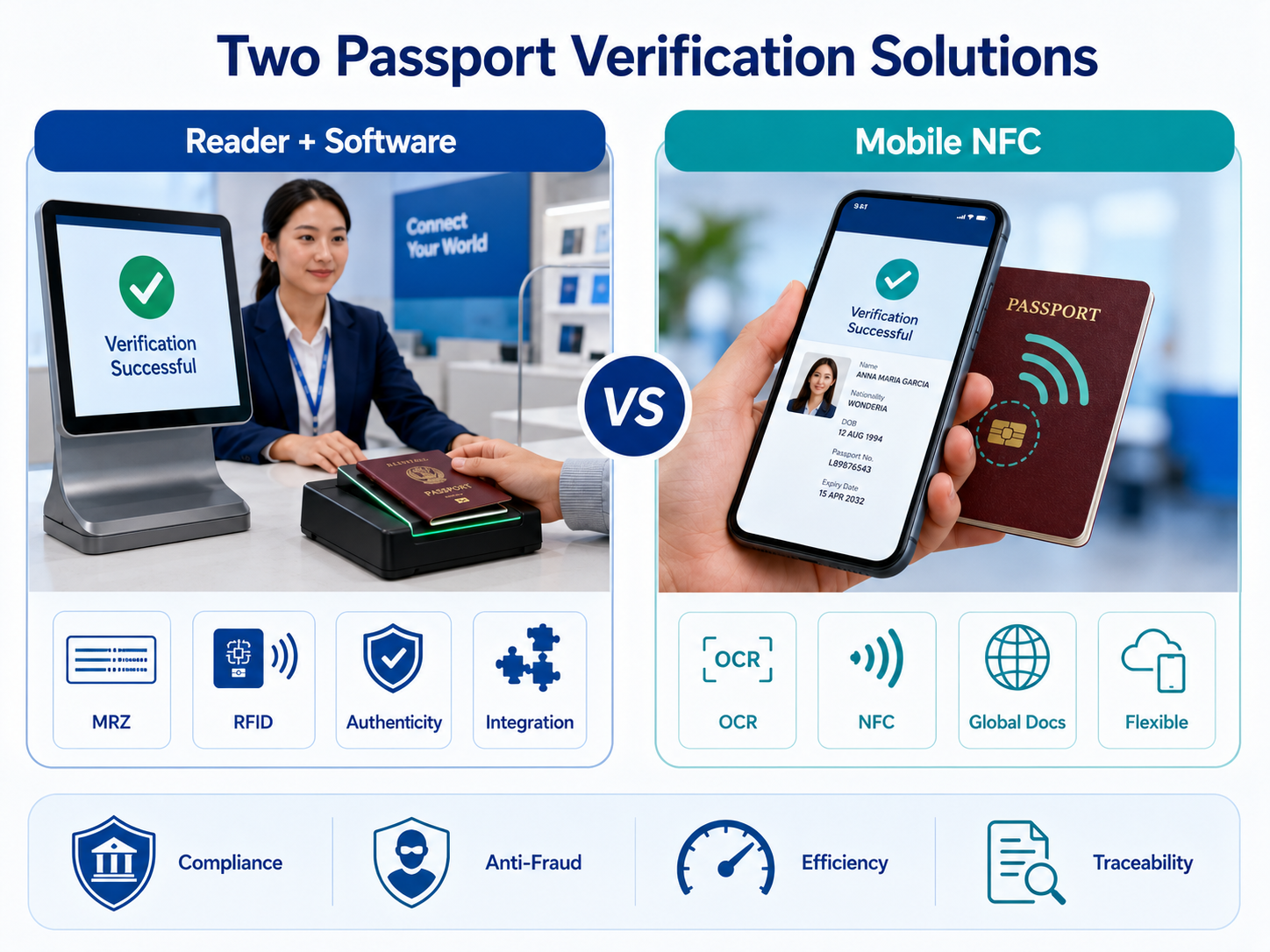
To meet the telecom industry's combined requirements for compliance, authenticity verification, and processing efficiency in foreign SIM registration, Sinosecu offers two complementary passport verification solutions that can be deployed independently or in combination, depending on the scenario.
Solution 1: Passport Reader + Professional Verification Software (Counter / Self-Service Terminal Solution)
This solution pairs a dedicated passport reader device with Sinosecu's professional passport verification software, and is well suited to standardized, centralized registration settings such as telecom retail outlets, airport service counters, and self-service SIM registration terminals.
At the point of registration, the system performs:
- Automatic passport reading (MRZ, document layout, data fields)
- Multi-layer security feature verification (layout consistency, field logic validation, etc.)
- E-passport chip (RFID) data reading
- Comprehensive passport authenticity determination
- Seamless integration with telecom registration systems, with results transmitted and logged for full traceability
This solution offers high stability, accurate recognition, and standardized workflows, making it well suited for centralized deployment at high-compliance, high-volume offline outlets.
Solution 2: Mobile NFC Passport Reading & Verification (Mobile / Online Solution)
In addition to the hardware-based solution, Sinosecu also offers a mobile NFC passport reading and verification system, designed for mobile registration, online-offline integration, and other emerging self-service scenarios in the telecom industry.
Sinosecu's Mobile NFC Passport Verification System is a document recognition solution built on OCR plus RFID (NFC) technology, available as an SDK for integration into:
- Native apps (Android / iOS / HarmonyOS)
- WeChat mini-programs
- Industry-specific self-service applications
System capabilities include:
- Recognition and verification of a wide range of global documents, including passports, Chinese resident ID cards, Home Return Permits, and Mainland Travel Permits for Taiwan/Hong Kong/Macao Residents
- Automatic reading of encrypted identity data and biometric data (such as facial images) from e-passport chips via the device's NFC function
- Support for e-passport reading across 178 countries and regions
- Legitimacy verification based on the ICAO PKD (Public Key Directory) framework
- Authenticity verification for e-passports from 130+ countries and regions
- Verification results that feed directly into the telecom real-name registration process, ensuring data authenticity and reliability
This solution requires no additional dedicated hardware, offers flexible and scalable deployment, and is particularly well suited to:
- Field-based registration
- Mobile registration counters
- Online pre-registration combined with on-site verification
- Self-service SIM registration for foreign nationals
The Value of Combining Both Solutions
By combining the passport reader solution with the mobile NFC solution, Sinosecu enables telecom operators to build:
- End-to-end passport verification capability across counter, self-service, and mobile channels
- A balance between high-compliance scenarios and lightweight, flexible use cases
- Flexible deployment across different carriers, outlets, and business models
Together, these solutions provide a unified, secure, and scalable identity verification foundation for foreign SIM real-name registration.
V. Summary of Solution Value
By adopting Sinosecu's passport verification systems, telecom operators can:
- Strengthen compliance with real-name registration and anti-fraud regulatory requirements
- Reduce business risk by preventing registration with forged documents or by non-matching individuals
- Improve processing efficiency, shortening registration time and reducing reliance on manual judgment
- Support scalable, replicable operations for foreign SIM registration services nationwide
VI. Conclusion
As the number of foreign nationals coming to China continues to rise and telecom regulation continues to tighten, the question is no longer whether foreign nationals can register a SIM card — but whether they can do so compliantly, securely, and efficiently.
Sinosecu's passport readers and passport authentication systems provide the telecom industry with a forward-looking, scalable identity verification foundation, helping operators strike the right balance between regulatory compliance and business growth.