The Future of Border Control Systems: Why Interoperability Matters
2026-10-16The New Border Control Stack: Why Interoperability Is Becoming the Core of Modern Border Management
Border control is changing. For many years, the process was simple from a passenger’s point of view. A traveler presented a passport. A reader captured the document data. The system checked the traveler’s biometrics. An officer or eGate then made the final decision.
Today, more systems are becoming part of this process. Identity data, travel history, biometric information, watchlists, visa information and pre-travel authorization may all need to work together. As a result, the future of border control is becoming less about a single eGate and more about how different systems connect and share trusted information.
The European Union is a good example of this change. Its Entry/Exit System (EES) became fully operational across the Schengen area on 10 April 2026. It replaced traditional passport stamps with digital records and records travelers’ personal and biometric data. At the same time, the EU is building an interoperability framework that connects major systems, including EES, the Schengen Information System (SIS), the Visa Information System (VIS), Eurodac, ETIAS and ECRIS-TCN. [1][2]
From a Smart Gate to a Connected Border
This change is about more than connecting databases. It is changing the role of the eGate itself.
In the past, an eGate could be viewed as a complete inspection point. It read a passport, checked a face and made a decision. In a connected border environment, the eGate becomes one part of a much larger system.
The EU interoperability architecture shows this clearly. The European Search Portal (ESP) allows authorized users to search relevant systems through one interface. The Common Identity Repository (CIR) brings together key identity information. The Shared Biometric Matching Service (sBMS) supports biometric matching. The Multiple-Identity Detector (MID) helps identify situations where the same person may appear under different identities in different systems.
According to EU-LISA, the ESP and CIR entered operations in June 2026. The overall interoperability framework is expected to reach full operational capacity in 2027. [2][3]
For airports and border-control technology providers, this creates a new priority. The question is no longer only how fast an eGate can process a passenger. The bigger question is whether all the systems behind the gate can work together and turn different sources of information into a trusted identity and a reliable border decision.
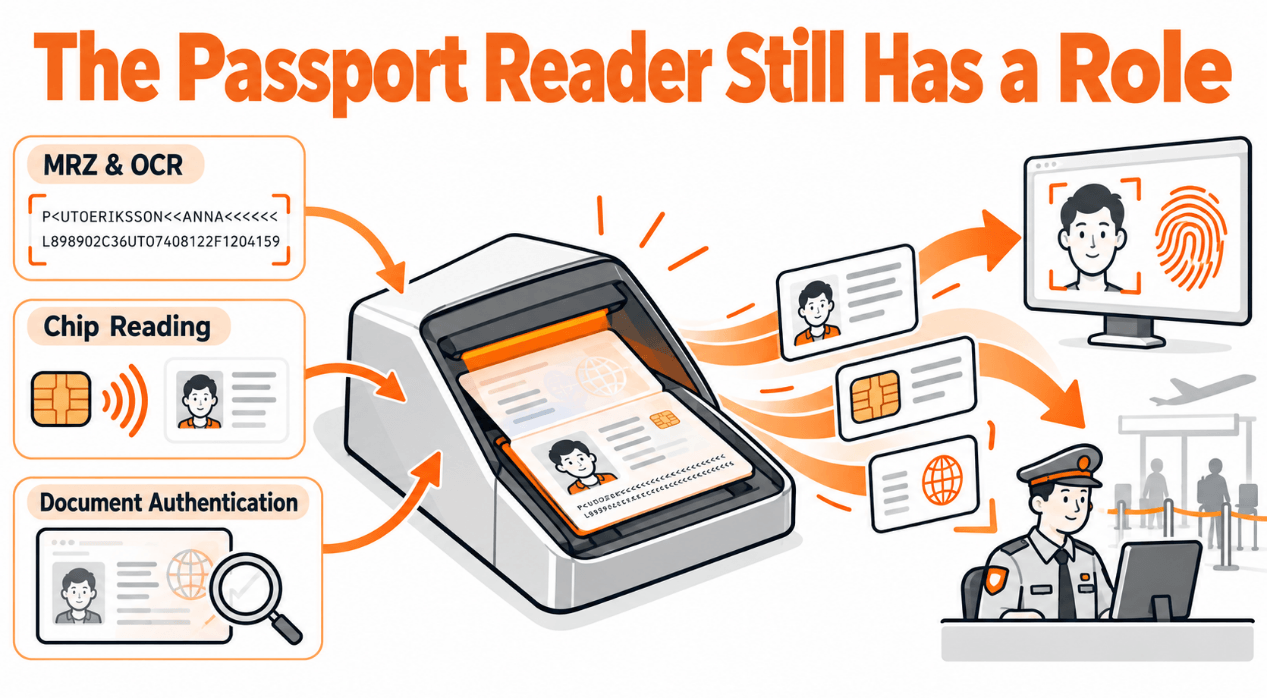
The Passport Reader Still Has a Role
As border systems become more connected, document reading will not be less important but more like the other way round.
Passport readers and document inspection systems provide the basic information that many other systems depend on. They capture biographic data, read the Machine Readable Zone (MRZ), access ePassport chips and support document authentication.
ICAO continues to recognize inspection systems and tools as an important part of its Traveler Identification Programmed. Its Public Key Directory (PKD) also provides the infrastructure for exchanging certificates used to authenticate electronic travel documents. [4][5]
The reason is simple: every later step depends on the quality of the data collected at the beginning. If OCR reads the wrong information, the problem may affect the entire border-control process.
This means document recognition should not be seen as a standalone hardware function. It is the first step in creating reliable identity data.
Biometrics Are Only One Part of the Picture
The same idea applies to biometrics. Facial recognition is becoming an increasingly important part of automated border control. For passengers, it may also become the most visible technology at the border. But a face match alone does not provide the complete picture.
A border system still needs trusted identity information, travel-document data, relevant authorizations and security checks.
The future is therefore not about choosing between documents and biometrics. Instead, document recognition, biometric verification and identity information need to work together. This is where interoperability becomes critical. Each technology may perform a different task, but the traveler needs to experience one simple and secure process.
Building the Border Control Stack for the Future
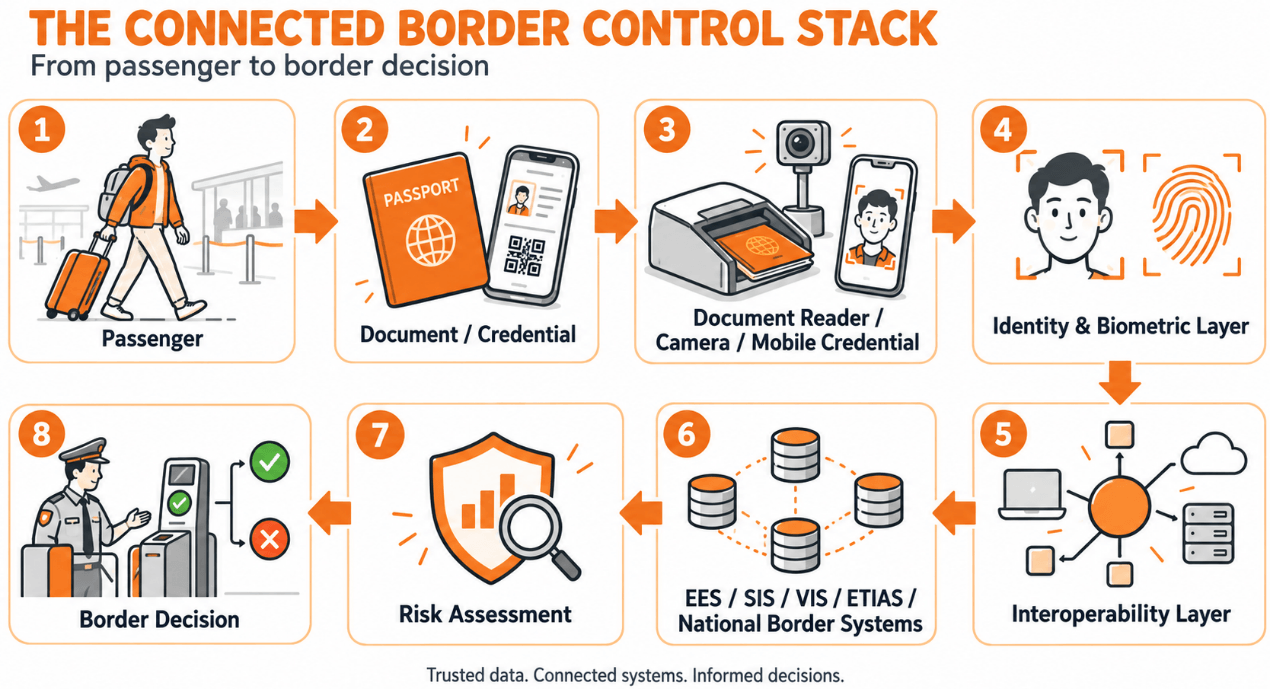
The next generation of automated border control will likely use several technologies at the same time. Cameras and biometric systems will capture the traveler. Passport readers and NFC interfaces will collect document information when required. Document authentication and biometric verification will help establish trust. Interoperability services will connect this information with the databases needed for the border decision.
At the final stage, policy and risk systems can determine whether the traveler can pass automatically or should be referred for further inspection.
ICAO’s 2026 update to the PKD is another sign of this wider development. The organization describes the new system as supporting the authentication of electronic passports and digital travel documents, while also enabling new possibilities for remote document authentication and verified biometrics in travel processes. [5]
For airports, this means that future border-control investments should not be judged only by eGate throughput. The ability to connect systems, maintain high-quality document data, match identities accurately and integrate new technologies will be just as important.
The next generation of border control will not simply be about building a smarter gate. It will be about building a smarter system behind the gate.
The eGate may remain the point where a passenger crosses the border, but the real decision will increasingly depend on how well the entire border-control stack works together.
Sources
[1] European Commission. Entry/Exit System (EES) is fully operational. 10 April 2026. Entry/Exit System (EES) is fully operational
[2] European Commission. Interoperability. 30 June 2026. Interoperability
[3] eu-LISA. Interoperability. Interoperability
[4] International Civil Aviation Organization (ICAO). Traveller Identification Programme (TRIP). ICAO TRIP
[5] International Civil Aviation Organization (ICAO). New ICAO border system will enhance security and process travellers faster. 26 March 2026. New ICAO border system will enhance security and process travellers faster
By sinosecu